
How inventory analysis, eco reports, and canopy coverage together reveal the true state of an urban forest
Urban forest managers often focus on individual tasks—inspecting trees, planning maintenance, or responding to risks—but the real power of tree stock management emerges when we view the urban forest from a top down approach. I will talk more about the importance of Tree and Woodland Strategies in a coming post but for now I wanted to introduce the idea of managing our tree stocks as an urban forest from three interconnected angles: inventory analysis, eco reports, and canopy coverage. Each side reveals a different truth about environment services, resilience, and the scale of green equity and our urban forests.
1. Inventory analysis — Understanding Resilience
Inventory analysis is the backbone of urban forest planning. It tells you what you have and where you have it.
Most tree managers have an inventory in the form of asset management where we collect the same data about every tree we manage. Using this data, we can analyse the diversity of the trees on all levels. Not just looking at species but also age class, tree size, structural condition and health as well as pest and disease pressure.
This side of tree stock management is all about resilience. Where there is a diverse tree stock, there is a resilient urban forest. A resilient urban forest is one that can withstand storms, pests, climate stress, and urban pressures.
Without inventory data, resilience is guesswork. By doing a good quality inventory analysis, we can start to understand where there are gaps in the distribution. Once we understand where those gaps are, we can start to steer the urban forest through planting or replacement schemes towards a more resilient future.
2. Eco reports — Understanding Environmental Services
If inventory analysis tells you what you have, eco reports tell you what those trees are doing for you.
If the greatest value of the urban forest and the reason that trees are valued in the urban environment is their ability to make the places that we live and work to be more liveable and sustainable then we need to understand the environment services that they provide. Eco reports essentially apply the inventory numbers to given environment services statistics in order to understand what the trees are doing for the local area.
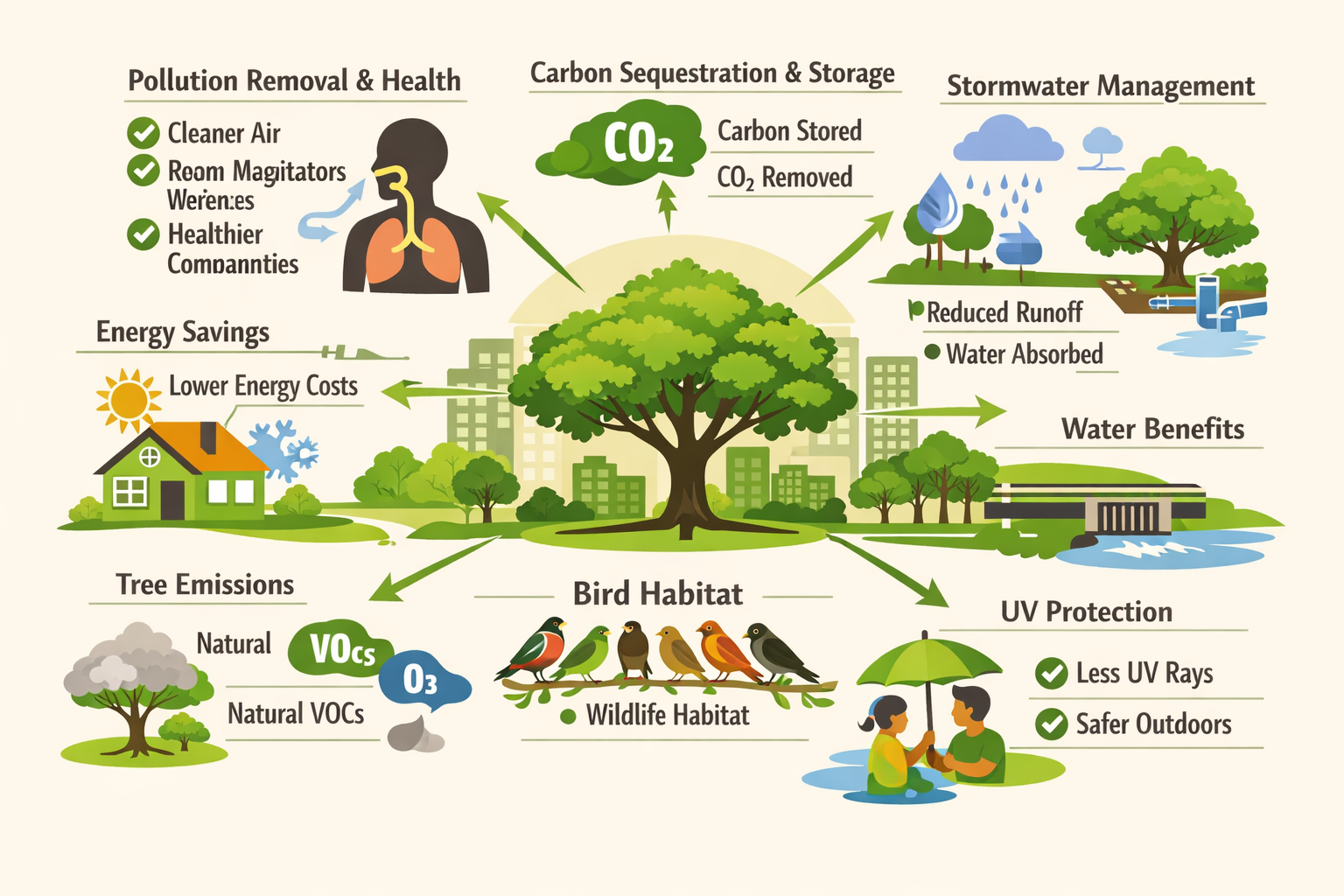
This side of the triangle highlights the value of the urban forest. It transforms trees from “nice to have” into measurable environmental assets and reinforces the reasons for having trees in our urban environments.
3. Canopy coverage — Understanding Extent
Canopy coverage analysis zooms out to the landscape level and then back in again. It allows for a more detailed observation of where the urban forest is and produces meaningful statistics that can be used to understand where the urban forest is and create growth targets and strategies. We can link canopy coverage with other national statistics such as social deprivation and pollution as well as looking into land use and ownership to understand stakeholder interest. By looking at canopy coverage, it answers questions like:
- Where is the urban forest located?
- Where is there a lack of green equity?
- Where can meaningful advances be made on canopy coverage?
- Where can we utilise specific strategies to target urban forest improvements?
This side of tree stock management reveals the extent of the urban forest. It’s essential for long‑term planning, climate adaptation, and ensuring fair distribution of green infrastructure.
Why All Three Sides Matter
Each side of the triangle provides a different lens to look at the urban forest. Each as important as each other and providing different insights into how we can make improvements to green provisions.
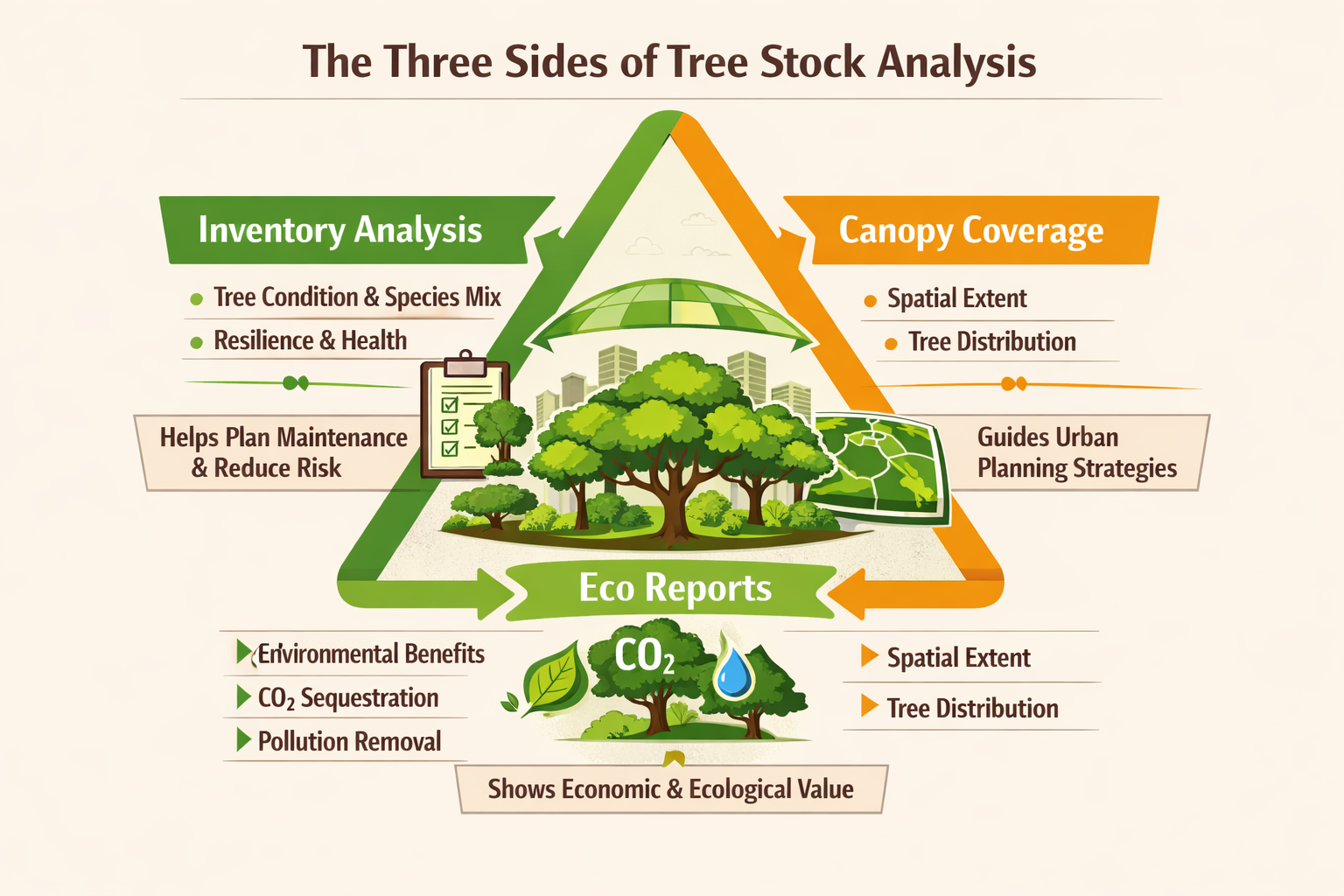
Together, they form a complete picture of the urban forest—its resilience, its services, and its scale.
The Takeaway
Effective tree stock management isn’t just about counting trees or reacting to problems. It’s about understanding the urban forest from multiple angles so that decisions are informed, strategic, and future‑focused. This is urban forest management from a birds-eye view and making landscape level decisions that will create a more resilient, equally distributed urban forest that provides the full extent of environment services.
When inventory analysis, eco reports, and canopy coverage work together, urban forest managers gain the insight needed to protect tree health, maximise environmental services, and build a resilient green infrastructure for generations to come.
If you want help to understand your urban forest at the greatest scale then please get in touch using the enquire here link at the top of the page.